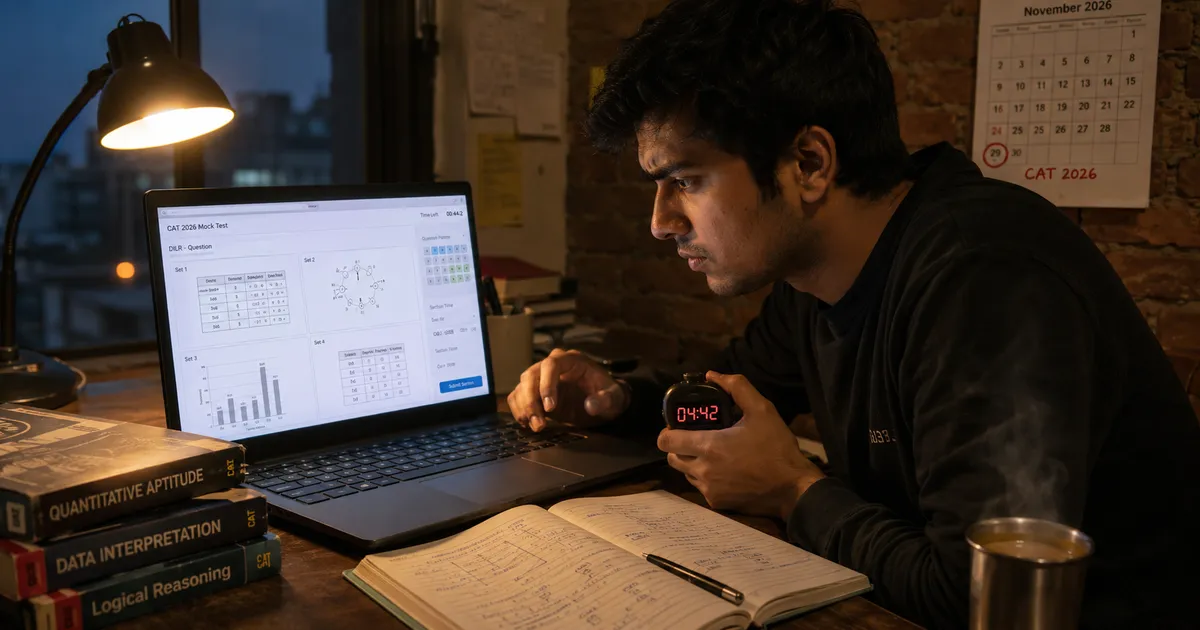
You opened the DILR section in your last mock. Four sets sitting there. You jumped into the first one — looked solvable — and by minute 12, you were stuck on a single value that wouldn't add up. By the time you bailed, three sets were untouched and panic mode kicked in. You scrambled through six questions in the remaining 28 minutes, got two right, and your DILR score crashed to 28 marks. Mock percentile: 76. You closed the laptop wondering if you're even cut out for CAT. The problem wasn't your reasoning ability. It wasn't your concept clarity either. The problem was your CAT 2026 DILR set selection — the 5-minute window that decides everything before you write a single equation. This blog is about fixing exactly that.
Why CAT 2026 DILR set selection matters more than solving speed
DILR is the only CAT section where attempting more questions can actively crash your percentile. In CAT 2024 Slot 1, the 99 percentile cutoff for DILR was around 41 marks — roughly 14 correct answers out of 22 total questions. The 90 percentile cutoff sat at 24 marks. That's a 17-mark gap between the two, and it almost entirely came from set selection — not from speed, not from concept knowledge, not from coaching quality.
Here's the math nobody talks about. Each DILR set has 4 to 6 questions, each worth 3 marks, with -1 negative marking on wrong MCQs. If you pick a brutal set and burn 18 minutes solving zero questions correctly, you've used 45% of your section time and earned nothing — possibly less than nothing if you guessed. Pick the right set instead, solve all 5 questions cleanly in 12 minutes, and you've earned 15 marks with 22 minutes left for your second set. Same exam. Same student. A 15-mark difference based purely on which set you chose to open first.
This is why CAT 2026 DILR set selection is treated as a separate skill by every IIM-A and IIM-C convert you'll meet. They didn't crack DILR by being smarter than you. They cracked it by becoming ruthlessly disciplined about which set to attempt and which to skip. The set you don't open is sometimes worth more than the set you finish. That sounds counter-intuitive. It's also the difference between a 95 percentile and a 99.4.

What most aspirants get wrong in DILR mocks
Three patterns destroy DILR percentiles, and you've probably done all three.
The first is sunk-cost commitment. You start a set, spend 8 minutes building the structure, hit a contradiction, and refuse to abandon it because of those 8 minutes already invested. So you spend 6 more. By minute 14, you've solved nothing and lost half the section. The 99 percentilers? They quit a set at minute 4 if they haven't found a clean entry point. Brutal, but it works. Sunk cost is the silent killer of CAT 2026 DILR set selection discipline.
The second mistake is set selection by topic preference. You see a Linear Arrangement set first, you love arrangements, so you start there. Topic preference is irrelevant. CAT examiners deliberately disguise easy sets in unfamiliar formats and difficult sets in familiar ones. In CAT 2023 Slot 2, the easiest DILR set was a Network Flow problem — a topic most aspirants actively avoid. The hardest set was a standard Distribution puzzle dressed up to look approachable. Topic familiarity is a trap when it comes to CAT 2026 DILR set selection.
The third mistake is skipping the scan entirely. Most aspirants open the first set and start solving immediately. They never look at the other three. If you don't see all four sets, you literally cannot compare difficulty — you're choosing blindly. CAT 2026 DILR set selection requires you to invest 5 minutes upfront — yes, 12.5% of your section time — purely on scanning, not solving. That investment pays back 4x in attempt accuracy on the sets you do choose.
These three mistakes account for roughly 80% of DILR percentile underperformance across CAT aspirants. None of them are about ability. All of them are about habit — and habit is fixable in two weeks of focused mock practice.
The 5-minute scan rule for CAT 2026 DILR set selection
Here's the framework that separates the 95 percentilers from the 99+ club. Effective CAT 2026 DILR set selection starts at minute zero and ends at minute five — before you've written a single number.
From minute 0 to minute 5: read every set. Don't solve. Just read carefully. For each of the four sets, ask yourself three specific questions in roughly 75 seconds.
The 90-second evaluation per set
First, what's the data structure? A clean table is friendlier than a paragraph description. Diagrams beat narratives. If you have to re-read a set's premise more than twice in 60 seconds, that set is probably engineered to confuse you. Skip it for now.
Second, can you predict the first equation? In every solvable DILR set, there's an obvious starting point — a row total, a unique constraint, a forced placement, a single value that pins everything down. If you can mentally visualize step one within 90 seconds of reading, the set is workable. If you're 90 seconds in and still don't know where to begin, the set is either genuinely hard or designed to trap your time. This is the core diagnostic in CAT 2026 DILR set selection.
Third, how many questions does the set carry? A set with 6 questions is worth 30% more raw marks than a set with 4 questions. If two sets feel equally workable in your scan, pick the one with more questions every single time.
After scanning all four sets, rank them mentally — best to worst. Attempt your top 2 cleanly. If time remains, take a third. Don't touch the fourth no matter how guilty you feel. This is what 99 percentilers actually do — and it's the working core of CAT 2026 DILR set selection.
The 5-minute scan feels expensive. It isn't. Aspirants who skip the scan typically attempt 2.3 sets with 60% accuracy. Aspirants who scan attempt 2.1 sets with 85% accuracy. Net marks: scanners win by 12 to 14 marks every single mock. That's the difference between IIM-Indore and IIM-Calcutta.
Where most CAT 2026 DILR set selection advice falls short
The hardest part of fixing CAT 2026 DILR set selection isn't understanding the framework — it's executing it under exam pressure when your hands are shaking and the timer is bleeding. The fastest way to internalize this is to talk to someone who actually scored 99+ in DILR last year and walk through their exact mock decisions, set by set. The challenge is that most IIM students don't take random calls, and the ones who do mentor are tough to find. Platforms like eSalahKaar let you book per-minute calls with verified IIM-A, IIM-B, and IIM-C students who can review your last mock with you live — so you pay only for actual conversation time with someone who went through the exact same panic two years ago. Worth bookmarking if you're stuck around 85 percentile in DILR right now.
How CAT 2026 DILR set selection plays out on real exam day
Here's what surprises most first-time CAT takers. The actual exam DILR feels different from mocks. Mock DILR usually has 1 easy, 2 medium, 1 hard set — predictable. Real CAT DILR in 2024 had 2 medium-hard sets and 2 traps. There was no "easy" set anywhere. The 99 percentilers attempted 2 sets cleanly. The 75 percentilers tried 3 sets and failed at all three.
This means your CAT 2026 DILR set selection process needs to assume worst case. Practice your 5-minute scan with the assumption that there's no easy set on the actual paper. If you can identify the "least painful" set in 5 minutes, you'll outperform 80% of test-takers in the same room.
Also: don't trust mock difficulty as a proxy for CAT difficulty. iQuanta, IMS, and Career Launcher mocks are typically harder than the actual exam. TIME and Bulls Eye mocks are typically easier. Your real CAT 2026 DILR experience will sit somewhere in between. Build your set selection muscle on the harder mocks. The actual exam will feel manageable in comparison. Resources like iQuanta's free DILR sectional tests are useful here — they're known specifically for high difficulty calibration that mirrors the worst-case CAT slot.
Other ways to fix your CAT 2026 DILR set selection
A live mentor call isn't the only path. Three other legitimate approaches work — each with honest trade-offs.
Coaching class DILR modules. Career Launcher, IMS, and TIME all offer dedicated DILR workshops, usually 8 to 12 sessions over 2 months. They cost ₹15,000 to ₹30,000 and work well if you're starting from zero and need structured input from day one. The downside: classroom pace is slow, faculty rarely customize feedback to your exact mock errors, and you learn the average student's strategy, not yours.
Free YouTube channels. Channels like Rodha, 2IIM, and CAT King have hundreds of free DILR set walkthroughs. Watching how a 99 percentiler approaches an unseen set — narration of their thought process — is genuinely valuable. Cost: zero. Downside: passive learning. Watching someone solve doesn't build the same neural muscle as solving 50 sets yourself, and YouTube doesn't tell you when your specific scan pattern is broken.
Discord and Telegram peer groups. Several CAT 2026 prep groups now run weekly DILR set-attempt sessions where 20 to 30 aspirants solve the same set live and compare strategies after. Free, community-driven, and surprisingly effective for set selection calibration. Downside: quality varies wildly group to group, and there's no expert oversight, so bad habits can spread fast.
Honest comparison: free YouTube plus a peer group is the cheapest path and works if you're disciplined. A coaching module works if you need structure and don't mind the ₹20K spend. A 1:1 call with a recent IIM convert works best when your mocks have plateaued and you need surgical feedback on your exact CAT 2026 DILR set selection patterns rather than generic advice that applies to everyone.
For broader prep planning, our complete CAT 2026 strategy guide breaks down the full timeline month by month, and the sectional companion piece on VARC strategy for engineers covers the verbal section in similar tactical depth.
One last thing before your next mock
If your DILR percentile in mocks has been stuck below 90 for the last five attempts, the fix probably isn't more practice. It's better selection. Take your last mock, look honestly at the set you opened first, and ask: did I scan all four sets before opening that one? Most aspirants haven't. That single 5-minute habit shift is worth more than 50 hours of solving practice. Try it on your next mock — set a stopwatch for 5 minutes, force yourself to read all four sets before writing anything. Then come back and tell yourself you knew.